Fiction
The Cost of Knowledge: Chapter 1
The Lexicon of Vanished Principles
No power comes without its cost. Even though we often forget this. We delude ourselves that we are in control, that we stand above such notions. I was the same.
We want acknowledgment, fame, prestige - believing these will make us whole. But the more we strive for them, the hungrier we grow.
I thought myself different. I knew power had a price, and I saw how it corrupted good people. So I chose the scholar’s path, thinking knowledge would be pure. That nature’s laws cared nothing for pride or greed.
How wrong I was.
I see it now. A truth as old as any proverb:
Knowledge is power. And there is no power without cost.
The first light of morning spilled across the city, catching the brass streetlamps and coal smoke that clung to the rooftops. Normally, I would linger in its warmth. Today I had no time.
I had risen two hours before the Bell of the Maiden, desperate to prepare for the conference. No great breakthroughs, only small progress with the thermometers. I prayed it would be enough to buy me time.
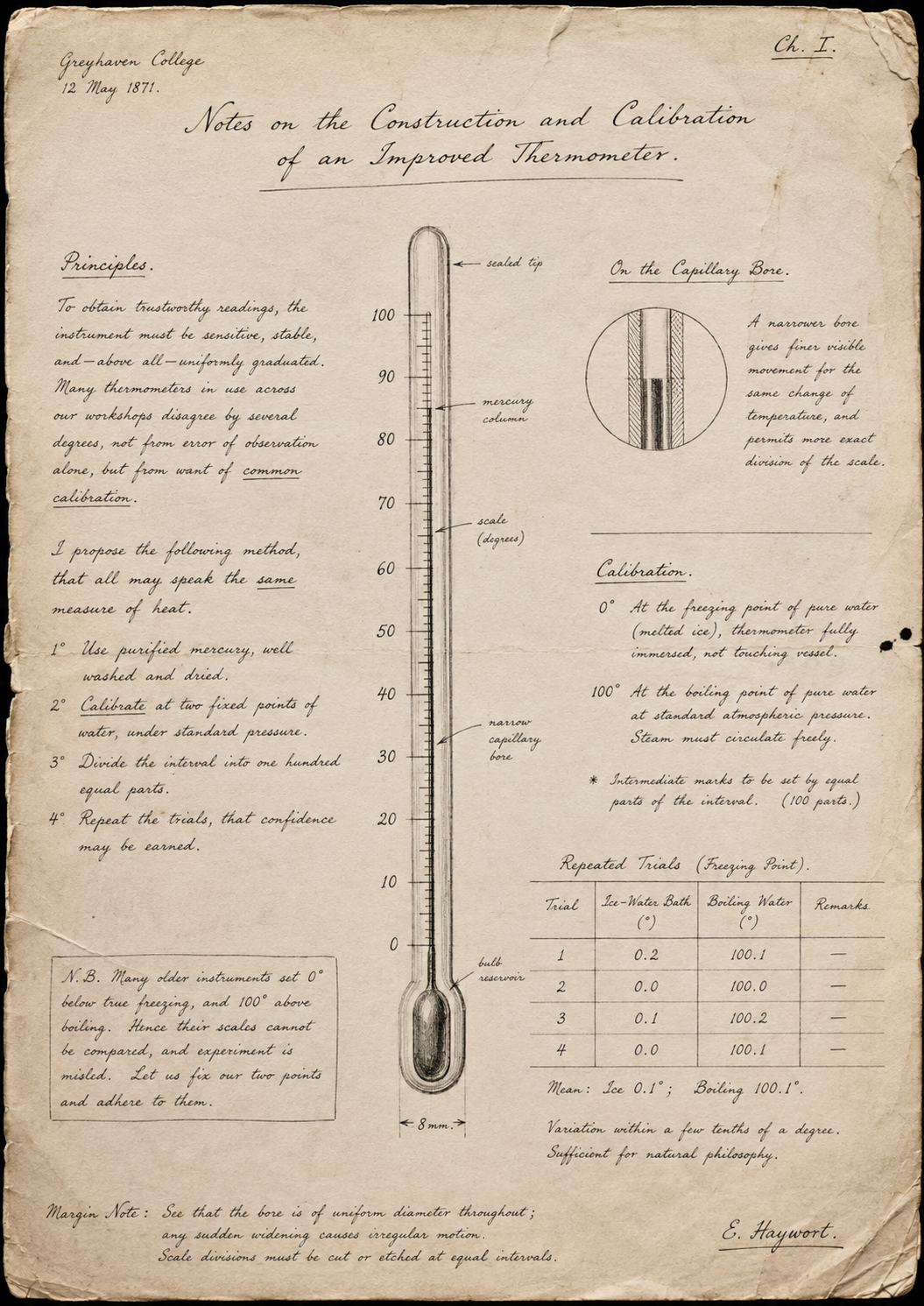
My latest drafts lay scattered on the desk, ink still damp: The Inconsistencies of Heat Engine Efficiency. On the Theory of Heat and Energy. Methods to Improve the Accuracy of Temperature Measurement - that last one unfinished, still lacking the precision I wanted. But it must suffice.
By the time I stepped into the college plaza, it was as crowded as the fisherman’s market on the day of the Gilded Flame. Freshmen rushed to claim seats in the lecture halls. Hollow-eyed scholars argued their theories in frantic tones. Professors strode with their assistants, calm as generals before a campaign. And then there were the others, like me - academics with faces drawn tight, carrying the weight of failure on their backs.
I was still gathering my courage when a hot cup pressed against my cheek.
“Here. Try this. From the Colonies. They call it coffee.”
Mika grinned like a boy playing a prank.
I took a sip. “Bitter. What is this made of?”
“Roasted seeds, from a tree in the Deimos Archipelago. Supposed to sharpen the mind. I thought you could use some, Eileen, with your presentation looming.”
Another sip. Still bitter, but the warmth spread through my hands. “Are you sure you’re not just using me as a guinea pig, Mr. Mika Salor - the great prodigy of the corpus?”
He laughed. “If I wanted to experiment on you, I’d study the effects of sleepless nights combined with unbearable stress. All I’d need to do is watch you.”
“How gentlemanly,” I muttered, though I could not deny the truth of his words.
His grin faded into concern. “Truly, though. How is it coming together? Should I be worried?”
“Fifty-fifty.”
“Fifty-fifty that you collapse? Or that you prove every skeptic wrong?”
“Fifty-fifty that I lose my funding for next year.”
“…Ah. Not good.”
“Correct.” I drained the last sip of the strange drink. “Where can I get more of this coffee?”
The foyer of the Grand Conference Room bustled with talk of the day’s presentations. Groups of scholars and students spoke so intently they hardly noticed when Mika and I entered. Or at least, I wished they hadn’t. For striding across the marble floor was none other than Edmund Rathmore.
“Miss Haywort,” he said smoothly, bowing just enough to show courtesy without respect. “I look forward to your… machinations with the thermometer. A pleasant diversion, though in the end, fruitless compared to more serious theoretical work.” His arrogance dripped from every word, and somewhere nearby a student let out a slight laugh.
“Lord Rathmore,” I answered, willing my voice to stay steady. “If even a conservative mind such as yours can see that without proper measurement we cannot improve the heat engine - or perhaps natural philosophy itself - then I must be doing something right.”
He tilted his head, smirk playing on his lips. “Engines have already been perfected by masters far greater than you or I. Only a fool reaches for the moons before her feathers have even sprouted.”
It took all my strength not to put my fist through that smirk.
“Cowards are the ones who hide in the shade of the Greats,” I shot back. “I will never consign myself to that fate. I refuse.”
I felt the professors’ eyes upon me, sharp and disapproving, especially from those of the older schools of thought.
Before Edmund could respond, Mika stepped forward with a smile that didn’t reach his eyes.
“Edmund, I haven’t seen you in a while. Still taking care of Eileen, I see. Funny. But you should probably worry less about her and more about the honor of House Rathmore. It’s your name on the line, isn’t it?”
Edmund’s smirk sharpened into a grin. He opened his mouth -
- but a voice cut across the foyer.
“Lord Rathmore,” called Professor Alder, striding toward us with brisk authority, his bronze cane tapping on the ground. “The Rector is waiting. You would not keep him waiting, surely.”
Edmund’s grin faltered. He inclined his head to the professor, then turned to me. “It seems fortune smiles upon you, Haywort. Let us see if her whim changes once we are inside.” His gaze lingered on Mika. “And you, Salor - I have not forgotten your remark. We will speak of it later.”
He swept into the Great Hall, coattails brushing the marble, and the crowd flowed on as if nothing had happened. No heads turned. No objections were raised. Business as usual.
“What a stuck-up prick,” I muttered to Mika, a small flame of triumph warming me. Then doubt crept in. “But… was it wise to provoke him? Your family still does business with his.”
“Not a problem,” Mika said with a bittersweet smile. “Edmund may be a conservative fool, but deep down he’s not as bad as you think. The two of you are simply… incompatible.”
Perhaps there was more between them than I knew.
“We should hurry, Eileen,” Mika added. “It won’t do for you to be the last to enter.”
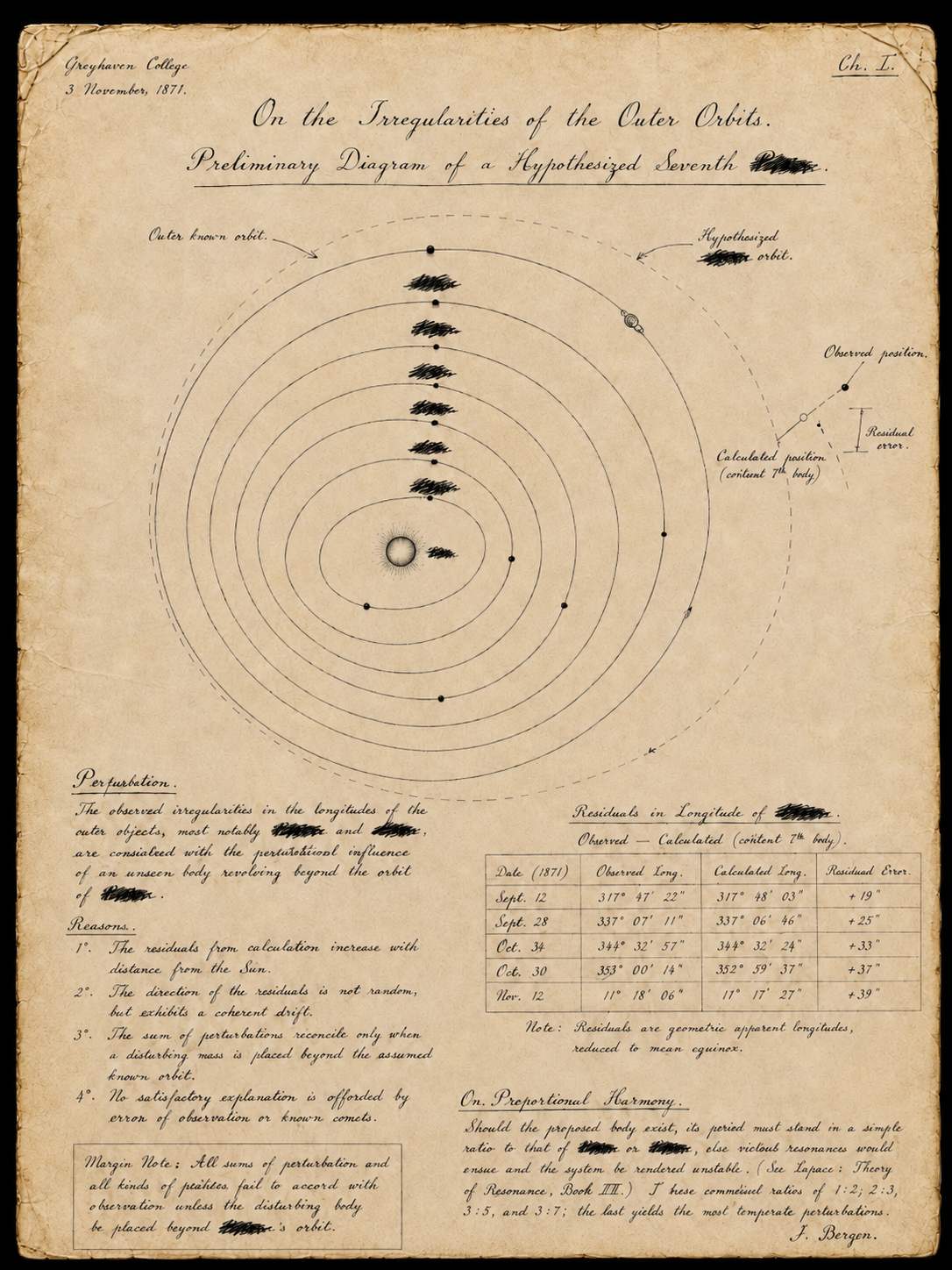
Arguments flew across the hall, technical terms hurled like stones. Voices rose, colliding, breaking into half-shouted rebuttals. On the elevated floor, Albrecht Bergen - a seasoned veteran of academia, his beard trimmed close and hands stained with ink - defended his paper on the cause of the slight errors in planetary orbits. His hypothesis, that even the smallest celestial bodies could tug at larger ones, their influence magnified across the vastness of space, was bold enough to shake the benches.
Mika, sleeves rolled to the elbow, was already dueling a gray-bearded professor over the details, astronomy being his favorite hobby. He nodded fiercely with Bergen’s reasoning, but I could see the flaw. The equations only balanced if one accepted a theoretical seventh planet, placed far beyond the outermost orbits. That was absurd. Surely we would have seen such a body by now.
“Quiet!” thundered the Rector, his voice reverberating against the red-paneled walls. Rector Aldous, tall as an oak and just as gnarled, leaned heavily on his staff of bronze. His white beard shook with every syllable. “Bergen, your logic is sound, but your mathematics rests on a phantom. Explain yourself.”
Bergen, a proud smile cutting across his hardened face, spread his ink-stained hands. “There is nothing to explain, Master. The numbers place the planet there, and so it must be. I have recalculated a dozen times. It aligns perfectly with Copern’s theory of resonance. I challenge anyone here to disprove my sums.”
The room erupted, benches rattled as scholars rose. Shouts, curses, profanities - the grand hall sounded less like a college and more like a tavern brawl, with constables ready to storm in at any moment.
“Silence!” Aldous bellowed again. A hush fell. “We will see, Bergen. But never speak in absolutes. What we hold true today may be overturned tomorrow. That is the nature of philosophy. Only the gods and the future know if we are right. We can only strive to be as certain as men may be.” He rapped his cane. “Greyhaven College will fund an attempt to verify these sums - and to seek this phantom planet.”
The crowd muttered, some scoffing, others intrigued. This was not the first storm Bergen had stirred, nor would it be the last.
“Now,” Aldous continued, his gaze sweeping the benches, “only one presentation remains on today’s agenda. Doctoral candidate Eileen Haywort. To the podium. Methods to Improve the Accuracy of Temperature Measurement.”
The Grand Hall seemed to shrink around me. The red walls pressed close, portraits of the Greats glaring down in silent judgment. How dare she mock great theories with talk of mere tools? How dare a woman address us as an equal? Their painted eyes seemed to whisper it.
I rose, heart hammering. Mika caught my gaze, offered a wink beneath his untidy gold curls. Meant as comfort, it twisted in my stomach - was it encouragement, or pity? Every step down the aisle between the polished wooden benches felt heavier. Indifferent eyes weighed me, some eager for me to stumble, a few curious if I might rise above them all.
At the base of the dais, four professors and Rector Aldous awaited. This was not my first presentation, but it might be my last.
Then a gentle hand rested on my shoulder. I turned to see Professor Erasmus Holt, his long silver beard neatly combed, his monocle catching the lamplight. His eyes, kind but sharp, steadied me.
“You always dig yourself into pits of doubt before these moments, Eileen,” he murmured. “That is your greatest weakness. Climb out faster.”
His words shook me awake, as they always had.
“Present as you do in my study,” he said. “Raise your ideas boldly. Bergen made your task harder, yes. But you will still rise. The Rector is waiting. Make us proud.”
I nodded, breath steadying. I would not fail.
I shook Aldous’s weathered hand, stepped onto the floor, and raised my voice.
“I present my latest findings on the improvement of accuracy in temperature measurement…”
Murmurs rippled through the hall. Sarcasm hissed between benches.
“…and how this enables us to uncover the hidden nature of heat itself.”
Silence fell.
“Let us begin.”
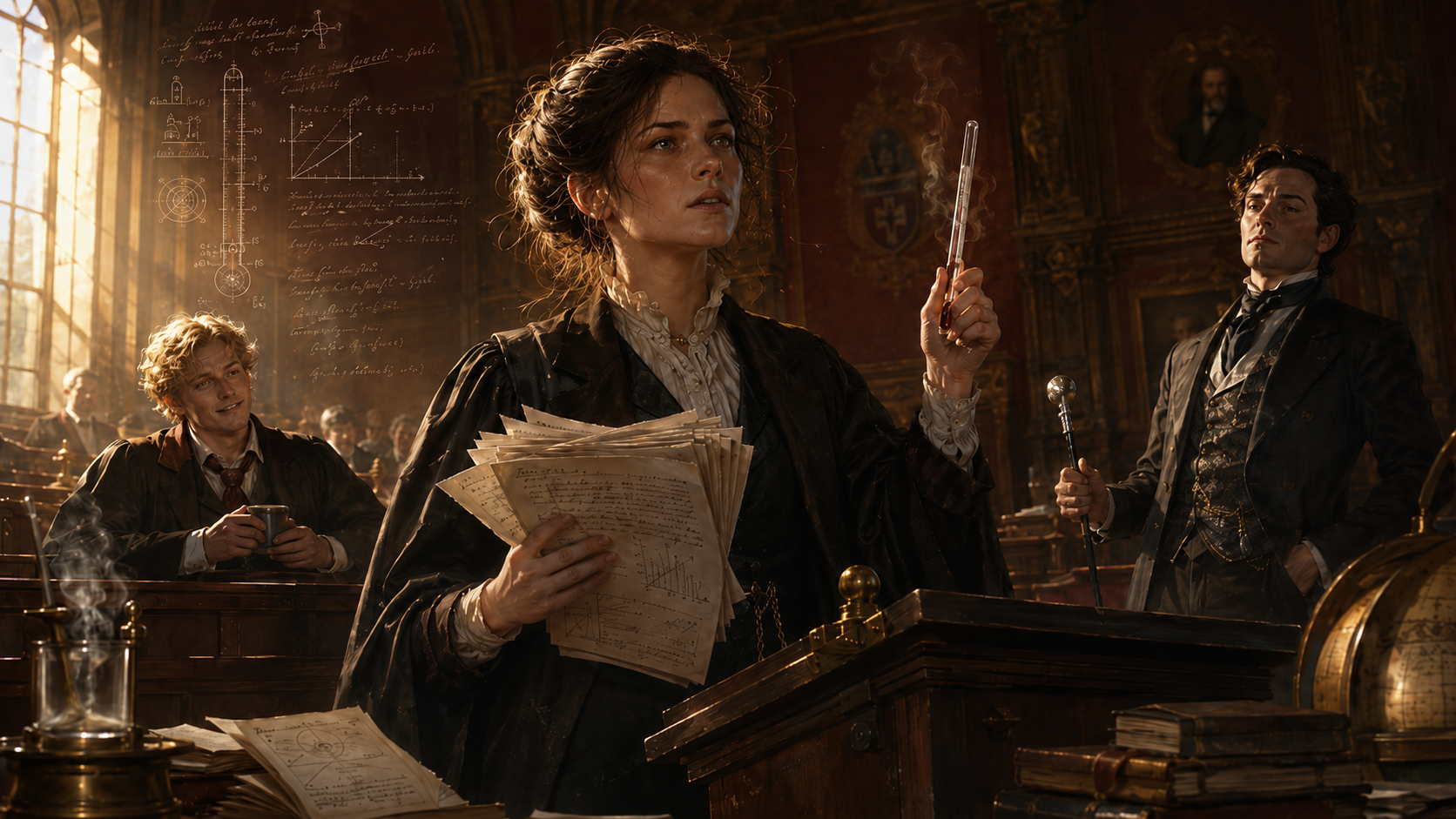
As I stood at the podium, I could barely contain the tremor in my hands. My black-and-navy scholar’s robe hung gently across my back, though the wool at my neck felt like an executioner’s embrace. My papers were already crumpled in my grip, and a lock of raven hair slipped loose to brush my cheek. I blew it aside rather than raise a hand - not with so many eyes watching. I could not let them glimpse weakness.
The aisle stretched before me like a gauntlet, each bench filled with names grander than mine. Painted eyes peered down from the walls, their scrutiny sharper than any living gaze. I forced myself to stand straight, loosen my grip, steady my breath. This was not my first time in this position. I might have felt small, but I would not bow. Not now. Not ever.
“I present to you my latest findings on the improvement of accuracy in temperature measurements…” I paused, weighing the next words. “…and how this enables us to uncover -” I let the silence drag, the hall holding its breath. Then, with a faint smile: “- the hidden nature of heat itself. Let us begin, shall we?”
The benches creaked as scholars shifted, quills scratching, eyes fixed.
“My esteemed colleagues speak of the greatness of heat engines, of how they are perfected. Yet we cannot explain why energy vanishes past a certain threshold. Where does this power go? I contend the reason even the greatest minds of Greyhaven have failed is not lack of intellect, but lack of tools.” I bit the corner of my lip unconsciously.
An older professor with an ashen beard sniffed. “Arrogant. She toys with instruments like a craftsman, not a philosopher.”
Another, freshly arrived from the capital, countered: “Perhaps so. But instruments gave us astronomy, microscopy, chemistry… Shall we ignore that?”
Holt, low to Aldous: “Listen to her, Rector. The girl has more steel than most of your men.”
Edmund’s voice cut through, smooth and disdainful. “You expect us to believe that a length of glass and a drop of tin will solve what masters of renown could not? Surely, you jest.” He leaned back, posture lazy, gray eyes unfocused - as though this entire affair were beneath him.
Laughter rippled among the older professors.
“No,” I answered, pulse quickening. “My point is this: what are theories without experiment to support them? And what are experiments without proper tools to conduct them? Would Master Bergen face such rebuttals if he had a telescope sharp enough to find his phantom? I wager not. Likewise, if we could make more precise, standardized measurements of heat, perhaps we would uncover the source of lost efficiency.”
A bead of sweat slid down my cheek. I ignored it. I felt the momentum shifting, the air itself turning, whispers moving like the tide. I was in.
Murmurs swelled across the hall.
One professor scoffed: “Utter rubbish. If it were so simple, others would have thought of it.”
Another shot back: “Yet none have.”
A knot of younger scholars scribbled furiously, one whispering: “She’s right - it’s how astronomy advanced.”
Rector Aldous stroked his beard, lost in thought.
“As detailed in my paper, I pursue this from two angles. First: the thermometers themselves. I have designed a narrower-bore capillary to yield more precise readings, and I replaced mercury with tin to eliminate the inconsistencies caused by impurity. The narrower bore magnifies even the smallest rise of liquid, turning guesswork into measurable increments. Tin, unlike mercury, does not falter with hidden impurities. Second: the standardization of measurements across workshops and colleges.”
The murmurs rose to a low uproar.
“Are you suggesting we have been inconsistent before?” demanded a stout, middle-aged gentleman.
Mika leaned forward with a grin. “Well, we’ve five different scales of measurement to begin with.”
The laughter that followed was uneasy, but I welcomed his voice. For the first time, I felt a touch of air in my lungs.
“I suggest we use naturally occurring, consistent phenomena to fix our measurements. Take the freezing point of water - let that be zero. Take its boiling point - call it one hundred. With such a scale, any workshop in any land can calibrate its instruments alike. A universal tongue for temperature, stable, reproducible, undeniable.” The words left my lips steady, exactly as I had rehearsed. Yet I knew the hardest part still lay ahead.
Edmund’s voice rang clear, no longer lazy but cutting. “Even with your perfect thermometer, you cannot pierce the mystery of latent heat. Water boils, takes energy, yet its temperature does not rise. Caloric explains this as the absorption of subtle fluid. Numbers alone cannot.”
They called it latent heat, I contemplated - the strange fact that once water reached its boiling point, it could swallow fire endlessly without rising any higher in temperature. Heat vanished into the transformation itself, hidden, as if consumed by some unseen hand. The caloric theorists claimed this proved their case: that a subtle fluid was absorbed, invisible to our instruments.
Several professors leaned forward. Rector Aldous stroked his beard. One graybeard muttered: “True. Without caloric, it makes no sense.” Another, younger, murmured: “Or perhaps it means caloric is wrong…”
Students on the upper tiers clutched their pens, leaning over the rail, hungry for every word.
“If our measures contradict our theory,” I answered, my voice trembling but firm, “then it is not the measure that fails but the theory. Precision is not an end - it is the knife that cuts truth from error.”
“Hubris. Pure hubris,” an elder hissed.
Another professor whispered back, grudging: “And yet… she makes a point.”
Above, the students’ eyes widened, ink smeared as they scribbled too fast to let it dry.
Edmund leaned forward now, eyes sharp. His tone lost its mockery, alive with genuine fervor.
“Suppose I grant you your instruments. Suppose they show, beyond all doubt, that efficiency is less than our theories predict. Then what? You will have sharper numbers, yes. But will sharper numbers tell us why the power vanishes? Or will you simply chart our ignorance more precisely?”
A hush spread through the hall, heavier than any scorn. Even the staunchest old guard weighed his words. From the corner of my eye, I caught Mika’s lips curling into a grin. For a heartbeat I feared he was right - that I was only charting ignorance in finer lines. Then the thought burned away. No. A sharper blade still cuts.
Edmund pressed on. “Consider the boiling of water. The point shifts with altitude, with the weight of the air itself. If your instruments could map such changes faithfully, then perhaps we might compare the Capital to the high peaks of the Marrow, or even Greyhaven to the Colonies, without contradiction. In time, such tables might reveal patterns hidden from us now.”
A murmur rippled through the benches - surprise, interest, even admiration. Holt’s brow arched. Mika’s grin widened. I could scarcely believe such brilliance had come from Edmund’s mouth. I can use this, I thought. For a heartbeat, I almost saw him as an ally.
Then the mask slipped back. His smirk returned, colder than before.
“Yet even if you succeed, Haywort, what will you have? Numbers, charts, tables - a grand record of ignorance dressed in finer clothes. Trinkets for craftsmen. Philosophy demands more.”
Groans echoed across the hall. Some impressed, some frustrated. A student whispered: “He nearly convinced himself.” Mika chuckled under his breath, half amused, half proud that I had drawn Edmund so far out of his shell, even if only for a moment.
“Enough.” Aldous’s cane struck the dais, the bronze ring cracking through the chamber. Silence fell.
“Haywort, your work is sound, though incomplete. Too few among us remember that progress lies not only in lofty theories, but in the humble tools that make them possible. For this reason, I acknowledge your rigor. Greyhaven College will create a board to scrutinize your proposal of standard measurement. But until your instruments reveal where the lost power of engines goes, your funds are halved. Prove yourself by next year, or let the annals of history devour you.”
The verdict rippled through the benches, murmurs swelling and fading like waves against stone.
I had survived - for now. The weight lifted from my shoulders so suddenly I nearly collapsed where I stood. Praise and recognition faded quickly, replaced by the cold reality of my half-success. A long year lies ahead.
I bowed my head to the professors and to Rector Aldous. As I turned from the dais, I caught Edmund from the corner of my eye, deep in discussion with his peers. For the briefest moment, I thought he looked… dissatisfied. His jaw tight, his finger tapped the cane as though to beat back words unsaid. Then the thought fled. Imagination, nothing more.
The robe still clung to my neck, but no longer like an executioner’s noose - more like a chain I would learn to bear.
The foyer now felt like a pleasant garden of knowledge as I stepped out of the Grand Hall. The oppressive weight I had carried during my presentation lifted. Murmurs still swirled as others passed beside me, but I cared little for them. Only Edmund’s hypothetical rang in my mind, repeating like a struck bell. I let out a short laugh. I never would have expected it.
“Already back to work mode, I see. If you keep this up, you’ll look the master’s part in a few years.” Mika’s voice rang out as he entered the foyer, grinning ear to ear.
“Nice work today. You managed to scare half the old guard to death. You and Bergen can now officially compete for who’s best at upsetting them.”
His jabs, lighthearted as they were, solidified my achievement. I wondered how I could ever have doubted his intentions.
“Only half, unfortunately. The other half has my funding,” I shot back with sarcasm, though a smile crept onto my lips.
He barked a laugh. “Fair. But you cracked Lord Rathmore’s shell. That’s a feat worth framing.”
His words froze me for a moment. Did Mika mean… Edmund’s hypothetical wasn’t a mistake?
“You mean his slip-up?” I asked. “If so, then at least he’s given me my next target of research.”
I nodded to myself, feeling the taste of triumph - until a familiar voice cut through.
“Alas, Miss Haywort.” Edmund’s voice came as his coattails brushed the marble. “Fortune indeed smiled on you today. To lose only half your allowance after that performance is miraculous.”
His smirk was present, but his eyes were distant. His fingers tapped against the silver head of his cane.
“Oh come now, Edmund,” Mika retorted before I could answer. His grin sharpened. “You nearly won her that half yourself.”
Edmund’s gaze snapped to him. “Can she not even speak for herself? You should guard your friend more closely, Salor, if she requires your tongue as well as her own.”
He swept past without waiting for a reply. “Remember,” he tossed over his shoulder, “I still owe you my word.” Soon, only his black hair and top hat were visible among the crowd of scholars.
“Still as big a prick as ever,” I whispered, more to myself than Mika. He only laughed.
The professors began to leave the hall, led by Rector Aldous. Their voices were low, unreadable. Then one familiar voice rose above them.
“Well done, Eileen.”
Professor Holt approached, silver beard gleaming in the gaslight.
“Thank you, Master. Your encouragement steadied me, as always.” I bowed my head slightly.
“The keen eye could see that,” Holt said. His expression darkened. “But your self-doubt is plain. You must master it. Public speaking is not something you can stumble through any longer.”
“I know, Master, it’s just-”
“No just.” His tone was sharp but not unkind. “Aldous noticed. So did the others. You were fortunate Rathmore drew their attention. Next time, you may not be so lucky.”
Heat rushed to my face. “I am sorry.”
“Don’t be. Be better.” His eyes softened with care. “Next week. Same time as usual.” With a stroke of his beard, he turned and followed the others.
“Farewell, Master,” I whispered.
Mika leaned in with a conspiratorial grin. “Shall we call it a day and find a bottle to celebrate?”
“Unfortunately, no. I still need to borrow some books.”
“Eileen…” He shook his head. “Even you need to rest.”
“Correct. But not yet. Not when I have inspiration.” My robes trailed as I turned toward the library.
Time slipped strangely once I entered the library. The lamps burned low, shadows pooling between the shelves. By the time I stacked my research volumes - Bergen’s equations, three treatises on caloric, two on metallurgy - it was already dark beyond the tall windows. Yet a tug, faint but insistent, told me I had missed something.
I wandered deeper, past the familiar wings, until the gaslight gave way to candles. Strange. This hall had been refitted last year - there should be no candles here.
The shelves rose taller, the air colder. The further I went, the less I could recall how many turns I had taken. A faint scent of extinguished flame clung to the air.
At last I found a shelf almost empty. Four volumes only, spaced as though waiting.
-
A Synopsis of Mechanical Humors
-
Principles of Inverted Pressure
-
Fragments Toward a Universal Calculus of Heat
-
The Lexicon of Vanished Principles
My hand moved before my mind caught up. The Lexicon slid free too easily, its dark leather too clean for its supposed age. A shiver climbed my spine. This, I knew without knowing, was why I had come.
The hall was silent except for my pulse. I opened it.
The text was impeccable - formulae elegant, reasoning smooth, conclusions inevitable. Every line felt as though the world itself had bent to match the argument. Devil’s reasoning, sweet and dangerous.
On one page, the ink shimmered. A flicker of light swelled into a sigil, then collapsed into a clean equation: Clausius’s theorem of efficiency.
My breath caught. I blinked. Only plain ink remained.
“What was that?” My voice faded into the dark.
Fatigue, surely. Mika was right - I needed rest.
I closed the Lexicon and hugged it to my chest.
Turning the corner of the third shelf, I froze. Somehow, I was back at my pile of books, as if I had taken no steps at all. My skin prickled. I had wandered much further. Yet here I stood, the Lexicon lying innocently among the stack.
At the counter, the clerk stamped the volumes with practiced boredom. While I waited, I noticed an ink stain on my hand I didn’t recall making. Strange.
“Seven books rented, Miss Haywort. Due in one month, or apply for extension.”
“Seven?” My voice cracked. “I… I brought eight.”
The clerk gave me a flat stare. “You carried seven to the desk.”
I checked. One by one. Seven. The ones I had chosen. The Lexicon was gone.
A chill raced through me, but the girl’s expression was unmoved. The world itself refused to notice.
Exhaustion pulled at me. I nodded, gathered the books, and stepped into the night.
Yet the feeling lingered - as if some weight pressed against my arms, warm and heavy, book-shaped though my hands were empty, and the faint smell of candlewax clung to my sleeves.
I told myself it was nothing. Fatigue. Nerves. The long year ahead.
But the vow burned still: I will not bow. Not now. Not ever.